
Chapter 1: The Biological Imperative
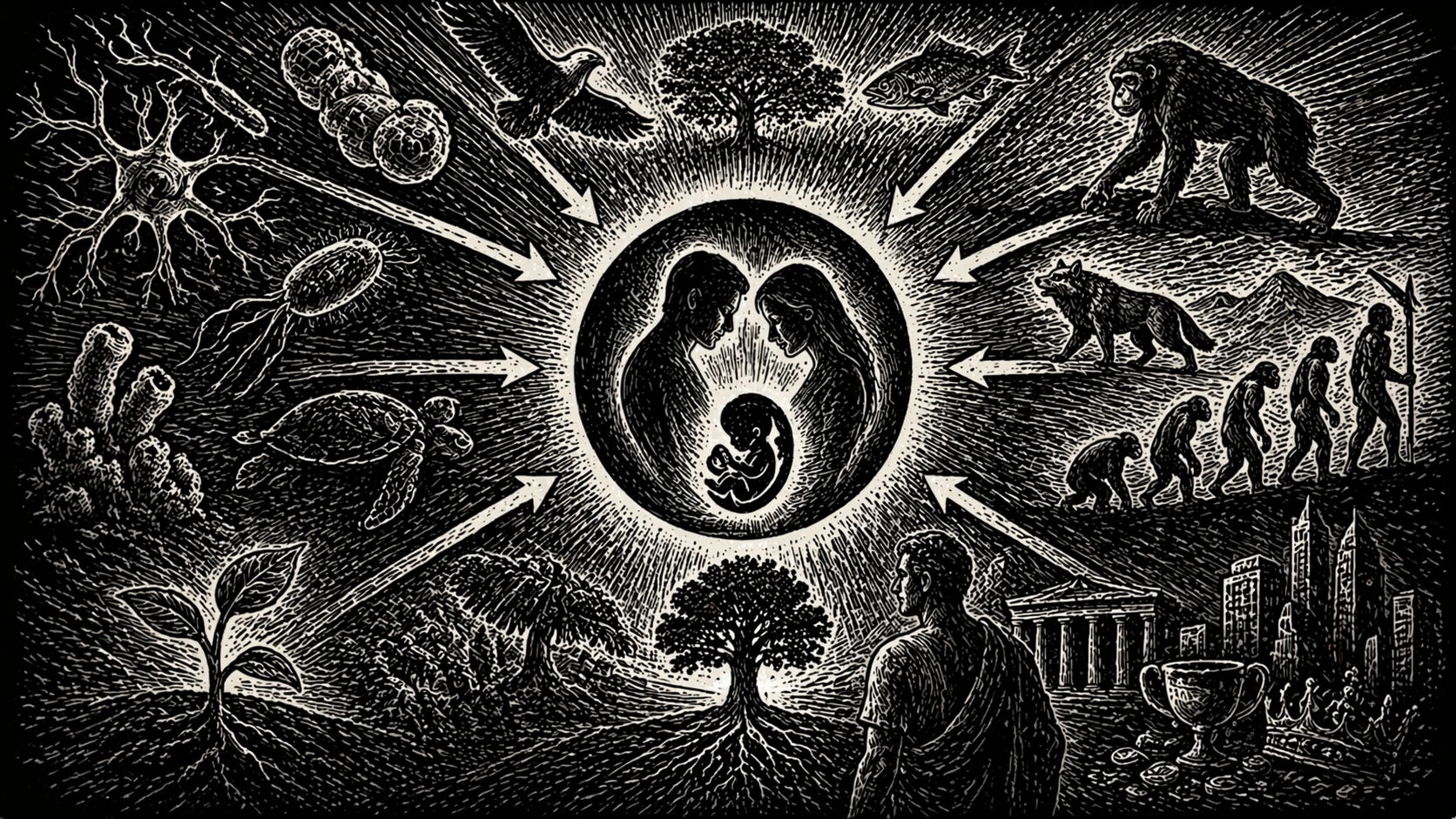
Every living organism is organized around a single outcome: reproduction. This is the common denominator of life.

This post is part of Understanding Women from First Principles, a series where I break down attraction and relationships from the ground up. Each post is a standalone chapter, but together they would form a complete framework.
See all posts here.
Starting from First Principles
If we are serious about understanding the relationship between men and women, we cannot begin with rules, opinions, or cultural expectations. We have to begin with first principles. That means we must ask the most fundamental questions and follow them all the way down to their root, without stopping midway because the answer becomes uncomfortable or inconvenient.
Most discussions about men and women never reach that depth. They remain confined to what men should do, what women should do, what is acceptable, and what is not. But these conversations assume that we already understand the underlying system. Most people don’t. Before we can talk about how men and women should behave, we need to understand why they behave the way they do in the first place.
That requires us to ask a more basic question: why do men and women exist at all? And once we ask that, we are forced to step outside of culture, outside of society, and look at life from a biological perspective.
The Common Denominator of Life
When you observe life at its most fundamental level, stripped of all complexity, one pattern becomes impossible to ignore. Every living organism, regardless of its intelligence or environment, is organized around a single outcome: reproduction. This is the common denominator of life. Not happiness, not success, not meaning.
Reproduction.
Even survival itself is not the end goal, but a mechanism in service of that goal. An organism survives so that it can reproduce. From this perspective, reproduction is not one goal among many. It is the underlying goal that shapes everything else.
Conscious Goals vs Biological Design
Now, as humans, we do not experience life in these terms. We have consciousness, ambitions, personal desires, and goals that appear completely unrelated to reproduction. A man may say that he wants to be successful, wealthy, respected, or accomplished. Another may say he wants to build something meaningful or pursue a passion. These are real motivations at the conscious level, and they should not be dismissed. But they exist on the surface.
If we look deeper, a pattern begins to emerge. These goals are not ends in themselves. They are means. They increase a person’s value. And that value, whether consciously acknowledged or not, plays directly into how attractive that person is as a mate.
This is where first principles thinking becomes useful. Instead of accepting surface-level explanations, we keep asking why. Why does a man want money? Why does he want status? Why does he want power or recognition? At some point, the answers converge. These pursuits increase his standing, his influence, his perceived and actual value. And that value improves his position in the mating landscape.
You can think of this as a hierarchy:
Surface-level goals: money, success, status, achievement
Underlying goal: increase value
Deeper function: become an attractive mate
Fundamental driver: reproduction
Even if an individual never consciously thinks about reproduction, the system driving his motivations was built for that purpose. This is also important to understand in context: the system that drives human behavior was shaped in an environment very different from the modern world. There were no careers, no financial systems, and no abstract constructs like wealth as we know it today. What existed were signals of survival capability—strength, competence, dominance, and social standing. The modern expressions may have changed, but the underlying wiring has not.
Men and the Pursuit of Value
This dynamic becomes especially clear when we look at men. A man is not automatically guaranteed success in the reproductive sense. He has to earn it. He has to build himself into someone who is desirable. This is why men work, compete, take risks, and push themselves. They pursue money, status, competence, and strength because these are the currencies through which they increase their value.
This is not a moral statement. It is an observable pattern. Across cultures and across time, men who have higher status, more resources, or greater competence tend to have more options. That is not because society arbitrarily decided it should be that way. It is because these traits signal something deeper—capability, stability, and the ability to provide and protect.
A man’s reproductive strategy, therefore, is not passive. It is active. He must create his value, signal that value, and compete with other men who are doing the same.
Women and a Different Evaluation System
Now compare this with women, and a different pattern emerges.
The question here is not what women are capable of doing. Women can build careers, earn money, and achieve status. Many do, and there is nothing inherently wrong with that. But if we are analyzing this from a first-principles, biological perspective, the question is different. The question is: what is required for reproductive success?
If you present a man with a woman who is physically attractive but has no career, no income, and no formal achievements, most men will still consider her a viable sexual partner. Her lack of status does not disqualify her. Now reverse the situation. Present a woman with a man who is physically attractive but has no ambition, no direction, and no ability to provide. In most cases, she will reject him.
This difference is not ideological. It is observable. It reflects the fact that men and women are evaluated on different criteria. For men, value often needs to be built. For women, a significant portion of value is already present, particularly in the form of physical attractiveness and reproductive potential.
Scarcity, Abundance, and Biological Asymmetry
To understand why, we have to look again at biology, but this time through the lens of scarcity and abundance.
Men produce sperm in vast quantities and continue to do so throughout their lives. Women, on the other hand, are born with a limited number of eggs. This alone creates a fundamental asymmetry. But it does not stop there. Reproduction imposes a far greater cost on women. Pregnancy, childbirth, and the physical risks associated with them make reproduction a significant biological investment.
A man, in theory, can reproduce with multiple women in a relatively short period of time. A woman cannot. She is constrained by time, biology, and physical cost. This means that while male reproductive potential can scale, female reproductive potential is inherently limited.
This is where the economic lens becomes powerful. What is scarce becomes valuable. What is abundant becomes less so.
Eggs are scarce → higher value
Sperm is abundant → lower value
Think of it this way: since there are infinitely more sperm and only so many eggs for the sperm to meet, it poses a challenge for the eggs in selecting the best of the sperm from the infinite pool.
In a zoomed-out view, what that means is the supply of men who want to mate with women is way higher than the availability of women. This poses a huge challenge for women because they have to be very selective in who they can mate with.
This creates a big value differential between men and women.
Because men have lower value in the mating market, not all men are able to reproduce. Only the men who can build themselves into high-value men can succeed. Whereas, because women have higher value intrinsically, most women require little effort at reproducing. In other words, there is almost always a man available to mate with a woman, but not vice versa.
This is not just a theoretical idea. It has played out historically. A large majority of women have reproduced, while a significant portion of men have not. This is a direct consequence of the asymmetry in reproductive biology.
This single fact has enormous implications for behavior.
Divergent Reproductive Strategies
Once you understand this asymmetry, the divergence in strategy becomes inevitable.
For men, the challenge is access. There are more men competing than there are guaranteed opportunities. A man cannot assume he will be selected. He must make himself worthy of selection. This is why men approach, initiate, compete, and take risks. This is why men are more aggressive in pursuing opportunities, including sexual opportunities. If a man goes out with the intention of finding a partner, his chances are uncertain and often low. He must overcome rejection repeatedly.
For women, the challenge is not access. A woman, in most cases, does not struggle to find potential partners. If she chooses to, she can attract attention and opportunities with relative ease. Her challenge is selection. She must decide which man is worth the cost of reproduction. The risk of choosing incorrectly is high, so she must be cautious, selective, and discerning.
Signaling, “Alpha,” and Incentives
Now consider what happens when men must compete for selection.
If a man needs to be chosen, he must signal that he is worthy. He must present himself as strong, confident, capable, and dominant in his environment. This is where the concept of the “alpha” comes from. An alpha is not a moral category. It is simply a man who signals high value through his behavior, presence, and position relative to others.
But wherever there is an incentive to signal value, there is also an incentive to exaggerate it. If appearing confident increases your chances, then there is pressure to display confidence even when it is not fully real. If appearing successful increases your chances, then there is pressure to present yourself in the best possible light.
This creates a natural tendency toward deception. Men are not only trying to be valuable. They are also trying to appear valuable, because appearance itself influences selection.
Women’s Filtering Mechanisms
Now look at the situation from the woman’s perspective.
If the cost of choosing the wrong partner is high, she cannot rely on what a man says or shows in the moment. Words are cheap. Signals can be faked. So she must rely on observation, testing, and filtering. She must look for consistency, strength, and non-verbal cues that indicate whether a man’s value is real.
These filtering mechanisms are often subtle and indirect. They are not always conscious or deliberate. But they serve a clear function: to reduce the risk of choosing incorrectly.
The Root of Tension
This is where tension begins to emerge.
Men are trying to gain sexual access. Women are trying to control the access. Men are incentivized to present themselves as high value. Women are incentivized to verify whether that value is real. Men may feel rejected, frustrated, or misunderstood. Women may feel cautious, selective, or skeptical.
Without understanding the structure behind these interactions, both sides often misinterpret each other’s behavior. But what appears irrational on the surface begins to make sense once you understand the underlying incentives.